
REFUND POLICY
Cancellations made 7 or more days in advance of an event date, will receive 100% refund. No refunds within 7 days of any event, but substitutions may be made.
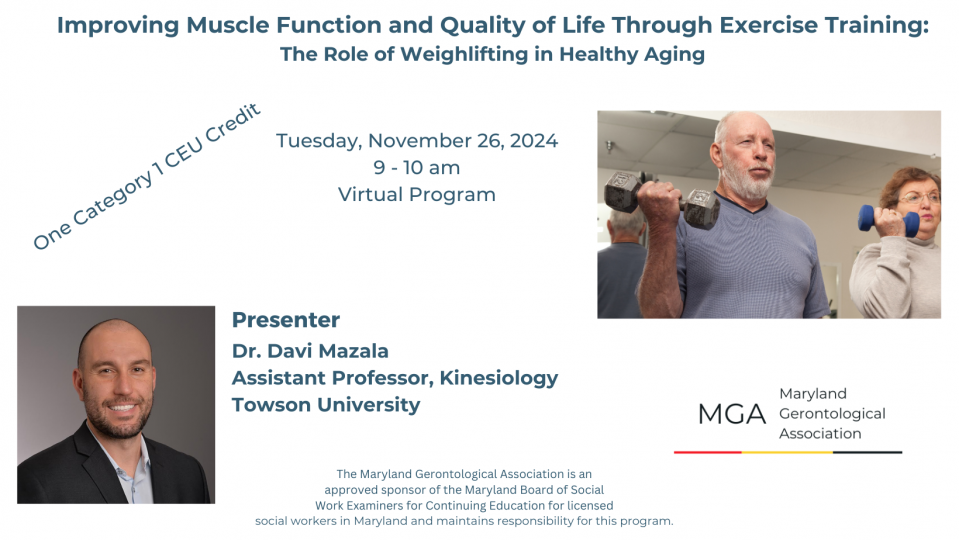
Improving Muscle Function and Quality of Life Through Exercise Training – The Role of Weightlifting in Healthy Aging
Description:
Aging is characterized by a gradual decline in muscle mass and muscle function, which will ultimately affect the ability of older adults to perform activities of daily living. While decreases in muscle function typically begin by the 5th decade of life at a rate of 1-2% per annum (this is increased to approximately 3% yearly after 60 years of age), and age-related loss of muscle mass generally starts by the 4th decade of life in which individuals start to experience a 1% muscle loss annually with the potential loss of 30%–50% of skeletal muscle mass by 80 years of age. In addition to the progressive loss of muscle mass and muscle strength, older adults also experience chronic low-grade inflammation which has been linked to an increased risk for comorbidities and mortality in this group of individuals. Weightlifting has been recommended as a method to attenuate the age-related loss of muscle strength and muscle mass as well as to potentially decrease chronic low-grade inflammation in older men and women.
Learning Objectives:
-
Understand the temporal changes in muscle size and function in older adults
-
Become familiar with the role of chronic low-level inflammation in older adults
-
Recognize the benefits of weightlifting in healthy aging
Presenter:
Dr. Davi Mázala started his education and training in 2004 in Brazil, his home country, and completed his undergraduate education in 2009 at the University of Maryland College Park. During his graduate work, he studied cellular and molecular alterations in muscle diseases, including Duchenne muscular dystrophy and Lou Gehrig’s disease (ALS). In 2016, he joined the Center for Genetic Medicine Research at Children’s National Health System as a NIH T32 post-doctoral fellow, and his research focused on evaluating satellite cell function as well as the role of the satellite cell niche on skeletal muscle regeneration (regenerative myogenesis) in muscular dystrophy and aging. His exposure to different areas of research as well as different models (humans and animals) has given him a broad view of the research spectrum – from studying whole body responses to exercise training to studying cell and molecular alterations in neuromuscular diseases. Since joining TU in 2020, Dr. Mázala has worked with older adults to evaluate the effects of exercise training with kettlebells on various functional (e.g., muscle strength, muscle power), physiological (e.g., vascular health, metabolism, blood biomarkers), and psychological outcomes. Additionally, Dr. Mázala’s lab is also interested in evaluating various functional outcomes and their relationship to muscle quality (i.e., ultrasound measurements) in individuals of different sex, gender, racial, and ethnic backgrounds.
Policy for Claiming CEU Credit
Maryland Gerontological Association offers Category 1 Social Work CEU Credit to those that attend a live session and complete the evaluation by the posted deadline.
To claim your CEU Credit:
- Attend the session in its entirety.
- Complete and return the mandatory program evaluation by the posted deadline.
Within 48 hours of the posted deadline, CEU certificates will be emailed to participants who have completed the evaluation. It is the responsibility of the participant to maintain accurate records of their credit hours.
REGISTRATION
$0.00 Member Registration
$15.00 Non-Member Registration
